
1. Enthusiasm has a shelf life
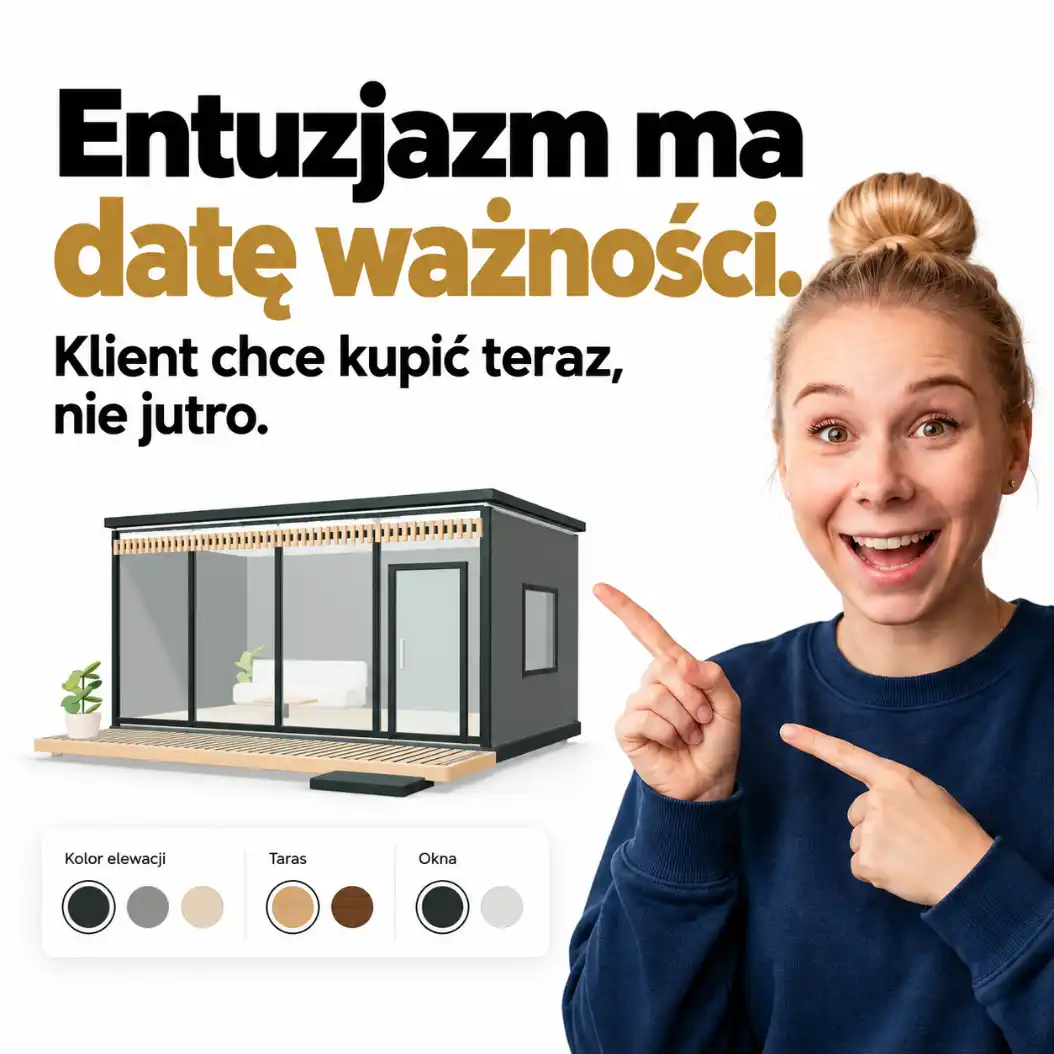
Your customer is interested now. A few hours later, something else may have their attention.
At 22:47, a couple decide to explore a modular home. They compare projects and imagine their future space. On a conventional website, they submit a request and wait. The next day brings work, children, shopping and other responsibilities. By the time a reply arrives, their attention is elsewhere.
With a configurator, they can choose dimensions, layout, exterior and a terrace while the idea is fresh. Each decision updates the preview. They can view an indicative price, save the project and send it to the manufacturer, or proceed to booking or ordering where available.
Their enthusiasm becomes a practical next step.
The Harvard Business Review article The Short Life of Online Sales Leads highlights the importance of responding promptly to enquiries. Its findings concern lead response, rather than proving a specific uplift from configurators, but the practical lesson is useful: make it easy to act while interest is high.
A configurator responds immediately to choices. Customers can resize a greenhouse, change a pergola, compare sofa colours or type a neon sign and preview the lighting.
They receive useful feedback at the moment they want to explore.
Your virtual sales tool can present options, calculate prices and guide the next step without waiting for office hours. In the morning, your team can review saved designs and enquiries generated overnight.
2. I can see it, so I want it

A product becomes easier to consider when customers can see the version they have in mind.
A shopper likes a sofa but wonders whether beige suits the floor, green velvet will look too dark or a right-hand corner will fit. Catalogue photographs show selected variants; technical descriptions leave some of the picture to their imagination.
Let them change fabric, colour, layout and legs, then inspect the furniture from different angles. A standard offer becomes a concrete vision for their own room.
Visualisation makes the choice more personal.
Interactive product presentation can help customers inspect details and assess alternatives. A 3D preview provides information that one static photograph may not communicate. Its value depends on the quality and accuracy of the implementation.
The same idea extends beyond furniture. A virtual fitting experience may show clothing on a customer's image or digital representation, depending on the technology. A greenhouse configurator can preview width, length, structure, doors and equipment. A terrace tool compares boards, colours, railings and roofing. A neon editor turns a typed phrase into a visible sign.
Customers can picture their purchase before it is manufactured.
The question shifts from “What would this look like?” towards “Does this version suit me?” A configurator gives people a useful way to discover your products and gives your team clearer purchase intentions to work with.
3. I helped build it, so it matters

People can attach greater value to something they helped create.
Michael Norton, Daniel Mochon and Dan Ariely explored this idea in The IKEA Effect: When Labor Leads to Love. Their research describes how involvement in creating an object can influence its perceived value. A configurator gives that idea a practical design application.
A customer starts with a modular home's basic shape, then changes the exterior, windows, rooms and finish. They add a terrace and adjust the roof. Each decision makes the result feel more like their own project.
It becomes their design, rather than one standard model in a catalogue.
The same process can happen with a sofa, greenhouse, fence, terrace, sign or personalised shoes. Customers invest time, attention and preferences, making the result more personally meaningful.
Consider a restaurant owner designing a neon sign. They type the business name, choose a font, test colours and adjust the size. Another supplier may offer a similar sign, but this design already reflects their decisions and brand.
The customer becomes an active contributor.
A useful configurator gives people a reason to stay: they can make something. The process can feel enjoyable, provided it is easy to understand.
Remove the burden. Make choosing enjoyable.
A terrace needs measurements. A greenhouse needs a structure and equipment. A sofa needs a fabric choice. A sign needs a design brief. The effort involved before seeing a result can discourage a buyer.
A well-designed tool guides them through available options, calculates prices and shows changes directly on screen. They can explore the outcome while the system handles technical rules.
The tool takes on technical planning and leaves the customer room to create.
They start with one small choice, compare another variant and gradually build a complete result. The product reflects their own decisions and needs. That makes moving from design to an order a more understandable next step.
4. It already feels like mine

A personal sense of ownership can develop before a purchase is completed.
Daniel Kahneman, Jack Knetsch and Richard Thaler studied the endowment effect: people can place greater value on things they consider their own. This offers a useful perspective when designing product personalisation.
A shopper finishes a sofa design, choosing the fabric, colour, modules and armrests. They inspect it and save it as “Our new sofa”. A moment earlier they were browsing; now they have a personal project to return to.
The purchase has started to become concrete in their mind.
A greenhouse customer imagines spring seedlings inside their selected layout. A business owner pictures their own neon sign above the entrance. The product may not exist physically yet, but their relationship with the idea has become more personal.
Saving a design gives that process continuity. Customers can return, share it with others, compare versions and refine the details.
On the final screen, the selected product and price are visible together. A clear next step such as “Order your design” connects the work they have done with the purchase process.
You are offering the opportunity to own something they helped shape, with a clear route from interest to involvement and then to a decision.
5. The first number sets a reference

A useful configurator lets customers discover upgrades and choose their value for themselves.
Amos Tversky and Daniel Kahneman described anchoring: early numerical information can influence later judgements. In a buying journey, the initial price becomes one reference point for comparing options.
Imagine a greenhouse starting at PLN 3,500. The customer chooses dimensions, then explores an extra ventilation window, irrigation, automatic opening or shelves. Each option shows its price and practical benefit, and the preview updates immediately.
The same approach suits a modular home with a terrace and larger windows, a sofa with another module or better fabric, a pergola with lighting, or a sign in a larger size.
Customers can see what an upgrade changes and decide whether it is worthwhile.
Compare a line reading “LED lighting + PLN 250” with the ability to switch it on in the pergola preview. The price remains clear, but the customer can also understand the result.
Personalisation can therefore support average order value when the choices are relevant. The tool presents possibilities at the right moment while keeping every extra optional and transparently priced.
Customers retain control, and your team can explain more of the range without manually discussing every accessory.
6. “Look — what do you think?”

A shareable design can turn one person's research into a joint decision.
Homes, sofas, terraces, greenhouses, restaurant equipment and signs are often chosen by more than one person. Partners, families or business owners need to agree. Household decision research from Pew Research Center also highlights the role of shared decisions in important purchases.
Explaining a design in words can be difficult. “A four-metre pergola, a dark frame, sliding roof and extra lighting” leaves plenty of unanswered questions about how it will look beside the house.
A customer who has configured the dimensions, colour, roof and lighting can instead save the design and send a link: “Take a look.”
The other person sees the result, checks dimensions, compares options and suggests changes. Both can review a version that matches their shared expectations.
A restaurant owner can send a sign design to a business partner. A family can compare sofa layouts. Future homeowners can build a modular home brief together.
The product becomes something people can share and refine.
For your company, sharing also creates opportunities for discovery. Someone receiving a design may ask who made it or explore their own version. The sales tool becomes an interactive experience customers can pass on.
A major purchase barrier? The work needed before buying
Businesses invest in advertising, photography and websites, while an important obstacle can remain in the effort required to make a decision.
A greenhouse buyer must choose dimensions, structure and equipment. A sign buyer has to explain lettering, size and the desired result. A clothing shopper compares photos and sizes while trying to imagine the fit. Each unanswered question can postpone the decision.
A configurator can take care of much of the technical process: guide the steps, show options, update a design, calculate a price and prepare an order or enquiry.
It turns complicated planning into guided choices.
Customers start with a useful structure rather than a blank page. Prompt feedback helps sustain interest. Visualisation makes the result tangible. Creating encourages involvement. Saving makes the project personal. Relevant extras enable comparisons. Sharing supports joint decisions.
Six mechanisms, one journey: helping customers move from “I'd like that” to a clear next step.
Your next sales tool can work around the clock
Imagine a tool that knows the available colours, sizes, materials and equipment. It patiently shows alternatives, lets people experiment and presents current prices. Customers can save a project, return later or share it. When ready, they proceed to an order or a prepared enquiry.
It can serve several people at once, on evenings and weekends, while each explores at their own pace.
A well-designed online configurator can play that role.
Its purpose depends on your products and customers. Furniture tools can configure sofas, wardrobes and kitchens. Construction tools can combine modular homes, garages, fences, terraces and pergolas. Garden tools can present greenhouses and structures. Fashion tools can offer personalisation or virtual fitting where supported. Advertising tools can design signs and branded items.
Other businesses can use guided selection for bundles, equipment, services and custom variants. The principle stays simple: help someone create a suitable option and make the next step clear.
A conventional catalogue presents products. A configurator lets the customer help shape one.
ANM Collective — turn customer ideas into orders
We create interactive configurators combining useful technology, visual design and a thoughtful buying journey. Each solution fits a particular product, industry and sales process.
From 3D previews and personalisation to virtual fitting, dimensions, materials, accessories, pricing rules and order submission, the objective is practical: help customers turn interest into action.
Think about the people who browse your offer and leave. Some cannot find a suitable variant, some struggle to imagine the result and others want options a standard page cannot explain. A guided tool may help them move forward.
Customers can spend time exploring your products, making selections and sharing a design within your own brand environment. When finished, they have a concrete version of their idea and a clear next step.
Try interactive product design for yourself
Explore our examples, change variants and see how customer-led selection feels.
Explore our configuratorsThen consider what a similar tool could do for your own range.
ANM Collective — you provide the products. We build tools that help people choose them.
Sources and research inspiration
1. Oldroyd, J. B., McElheran, K., Elkington, D. (2011). The Short Life of Online Sales Leads. Harvard Business Review.
2. Baymard Institute. Cart Abandonment Rate Statistics. https://baymard.com/lists/cart-abandonment-rate
4. Norton, M. I., Mochon, D., Ariely, D. (2012). The IKEA Effect: When Labor Leads to Love. Journal of Consumer Psychology.
5. Kahneman, D., Knetsch, J. L., Thaler, R. H. (1990). Experimental Tests of the Endowment Effect and the Coase Theorem. Journal of Political Economy.
6. Tversky, A., Kahneman, D. (1974). Judgment under Uncertainty: Heuristics and Biases. Science.
7. Pew Research Center (2008). Women Call the Shots at Home.